

Author’s Notes / Part 1 - Andreas
Part 1 - Andreas

Español | Português | Français
Author’s Notes / Part 1 - Andreas
First, thank you for reading eXis and for subscribing. Your reading keeps this project going; if you enjoyed it, please share it. It helps me a lot.
In this section I share the behind the scenes of each part: I will offer clues, tell how the characters were born, where the inspiration comes from, and answer your questions.
It is also a space where I can ask for your feedback and keep you up to date on the project. Here you can give me feedback and vote in polls, among other things.
The idea is to bring you closer to how eXis is made and to share the process with you: the decisions, the obsessions, and the small clues that sustain this first part.
Lastly, a light spoiler might slip through. Nothing major. But if you prefer to avoid them entirely, it might be better to read the whole book before coming into these author’s notes. (I recommend reading Part 1 - Andreas first to avoid spoilers.)
Welcome to this parallel reading space.
The Idea
eXis was born as a short story I started in school. It did not have a defined plot; it had a starting point: the smell of wet earth after the rain. In Lima rain is rare, and I did not know that smell until I visited the north of Peru. It stuck with me there as one of my first vivid memories. I wanted to convey that feeling because, for me, it sounds like a beginning: water waking the earth, a memory many of us share.
That feeling is what I wanted to transmit. From there I began to collect the crickets, the water running through the channels, my grandfather’s coop: materials from my childhood in the north of Peru that I wanted to gift to Gael.
The first time I shared this memory in a text, a friend told me, “I felt like I was in your grandfather’s coop.” That comment pushed me to write in earnest: the beginning, “El Pavo.” But I did not finish it until maybe fifteen years later, in a writing club during my master’s program at a university in New York.
eXis seeks to evoke your memories and leans on other arts to carry them. Each scene is designed to move to the screen, to have music, to breathe painting or poetry. This story is here to make you remember.
About Gael
This story is kind to Gael, for now. He does not live on feats; his ground is the everyday. He looks. He listens. Sometimes the storm falls on others and he takes note, understanding it when he can.
As I wrote, Gael slipped out of my hand. He showed me things I did not yet understand. He opens doors with details: a song, a stone, the hum of bees, mango juice on your fingers. eXis reaches for that, inhabiting small signs until they reveal what they hold. Everyday signals.
Gael resembles me, and still he broke away early. We share experiences and memory; that lets me read him closely without directing him. In this first part he is neither hero nor example. He observes. He offers you his world and, along the way, fine tunes ours.
I think an early mark sharpened his sensitivity. Since then he feels more than he says. At times he senses echoes he cannot name. He does not explain them. He records them and, in his way, hands them to us. I walk by his side as he learns to listen to what was already there.
About Andreas
Andreas is a mysterious character. His signature is to unsettle me. He shows up decisively when needed and keeps silent when it is called for. He chooses his battles. There is intelligence in his world and a kind of wisdom that does not need to assert itself.
Part 1 is, at its core, about Andreas. Warm tones lead the way: the countryside, the sun, nature, yellow fields, the animals.
I feared I had romanticized him, but no. Andreas is human, one of the good ones. He is not here to pose as a hero or to celebrate an easy life. He was dealt a rough road and learned to make the most of what there is. Building the character forced me to see him in layers: many layers, the visible and what he protects.
I will go deeper into him as we move forward. In this part, Andreas is the center of Gael’s world. He does not need to raise his voice to move the scene; he is the light that opens the way.
About the Grandfather
The grandfather is one of the best characters in this story. He carries contradictions and problems, constraints that in this first stage he does not display but that can be felt. He enters at key moments and with little shifts the direction. I wanted to write him that way because that is how it was in my life: he shows up, puts a piece in place, and leaves.
He has shamanic traits and, at the same time, a city side. He is noble, but also capable of a hard gesture with a child. We do not know his story, although we sense something troubles him. His temperament is eclectic and his compass is family: he acts to care for his own.
He has something of the father in Coco, the long fight of Latin American families, and a mysticism that brushes Peru and Mexico. He likes rancheras and Domenico Modugno, understands art and goes to the market, an intrepid criollo. He does not feel above or below anyone. He knows a lot.
He is a complex character because he brushes against mistreatment and violence toward a child. I decided to show him as real, without softening. From his first scene I wanted to explore his shadow and the tensions he carries, but also his impulse to protect the family. That friction defines him.
The animals
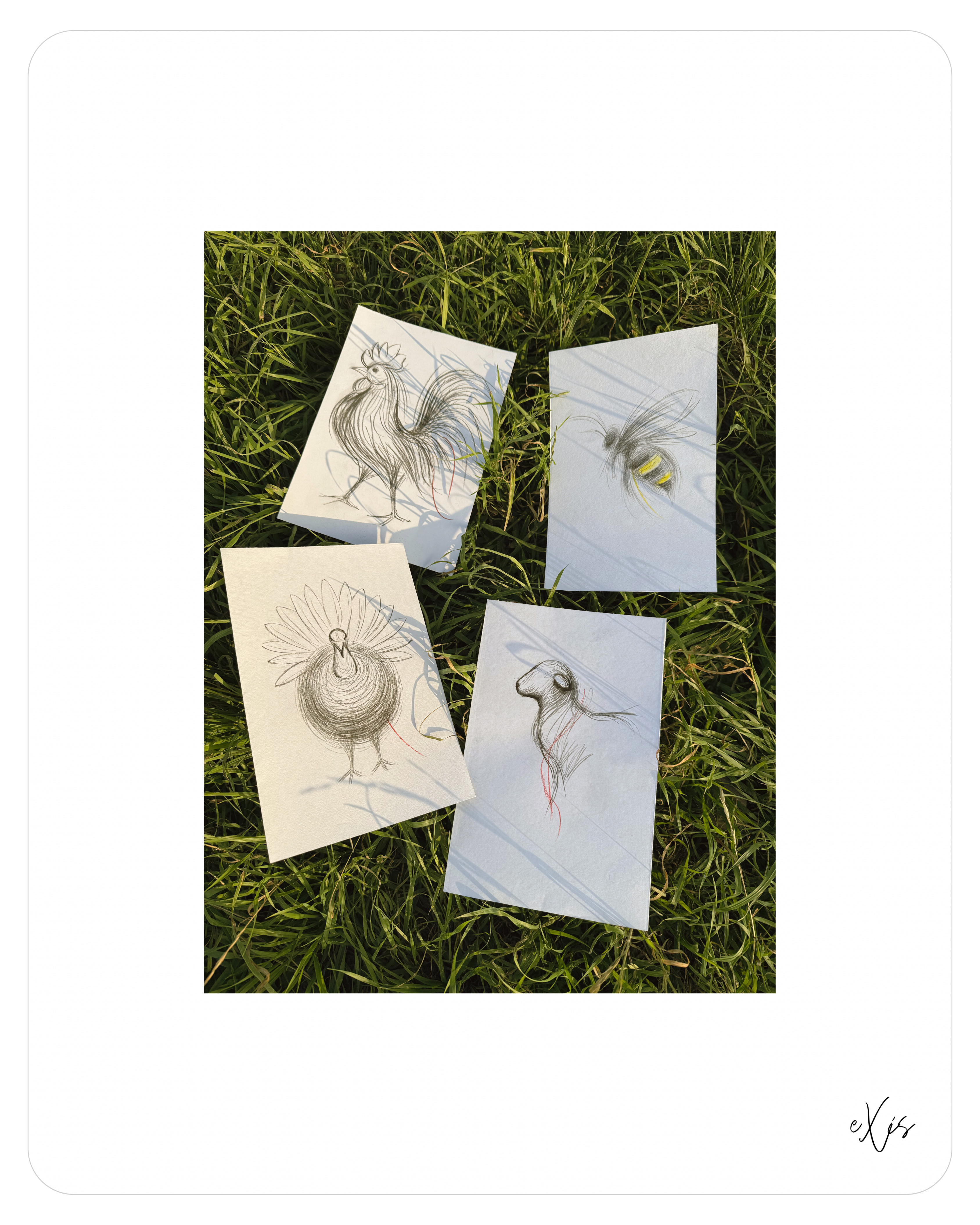
In this first part, nature and music act as characters. Four presences hold each scene: the turkey, the lamb, the bees, and the rooster. They do not decorate; they push the story and they push Gael.
The turkey is a warrior: it attacks in defense, out of not understanding, and it also leaves a sign. In case you have not followed the trail yet, eXis works with signals that drive us to keep going.
The lamb teaches sacrifice and its cost. The bees bring the sacred in the form of a hum; their presence reminds us that beauty can also wound. The rooster announces and marks thresholds.
I feel these “characters” help us humans understand reality and force us to move forward. They are agents of cooperation: with little, they move the characters and change their course.
Introductory texts
I am thinking of including these two texts as the opening of the print edition, before Part 1 begins. What do you think I should do I want to place the reader inside the story from the first page.
“Writer’s Note” works as a gentle warning: read from the memory each person brings.
“Our Story” reflects eXis’s bond with our shared humanity and with ourselves.
Writer’s Note
Read this book as if you were here.
In each story, imagine you are walking by my side.
That everything I once felt, you felt too.
As if, in some corner of your memory, this had already happened.
Imagine this story is not mine. It is yours.
And perhaps you are only remembering it.
Our Story
It was not a lightning bolt, or a ship, or a god with a name.
It arrived the way rain arrives: silent, inevitable.
The Earth turned young, with seas that boiled and skies that still smelled of stone.
Among dense clouds, an invisible current crossed the void.
It did not carry bodies or voices, only memory.
It was ancient, so ancient it had already watched entire worlds be born and die.
When it touched the atmosphere, it broke apart into invisible fragments that fell over the waters, the rocks, the seeds still asleep.
It did not alter the shape of anything; it altered the pulse.
What once only grew and died began to ask why it existed.
Millions of years later, that question woke in a pair of eyes. They were ours.
And since then we have carried it inside, without remembering that it did not begin here.
I’m listening: would you like to find the opening texts before Part 1 - Andreas? What feeling do they leave you with? Which character pulled you in? Which scene stayed with you?
Gon Vas
The Rooster ← Previous chapter | Index | Next chapter → Playlist / Part 1 - Andreas
Me encanta cómo todo nació de ese olor a tierra mojada. Reconozco completamente ese recuerdo sensorial que describes.
La forma en que construiste a Andreas es fascinante: "aparece decisivamente cuando es necesario y guarda silencio cuando se requiere". Esa contención es tan poderosa. Y el abuelo... qué personaje tan complejo y real. Me gusta que no lo hayas suavizado, que muestres esas contradicciones que todos llevamos.
Los animales como agentes de cambio es una idea brillante. Cada uno marca un umbral diferente en la formación de Gael.
Sobre tu encuesta: para mí, las abejas. Esa escena tiene algo hipnótico, el zumbido como presencia sagrada que mencionas se siente completamente.
Y sobre los textos introductorios: creo que "Nota del autor" funciona perfecto como apertura. Establece ese pacto de lectura desde la memoria compartida que es tan importante para eXis. "Nuestra historia" es hermoso, pero quizá podría funcionar mejor como epígrafe o al inicio de una parte específica.
Gracias por compartir este proceso. Es oro para los que amamos entender cómo se construyen las historias.
Un abrazo enorme .
Elías
TINCTA VERBA